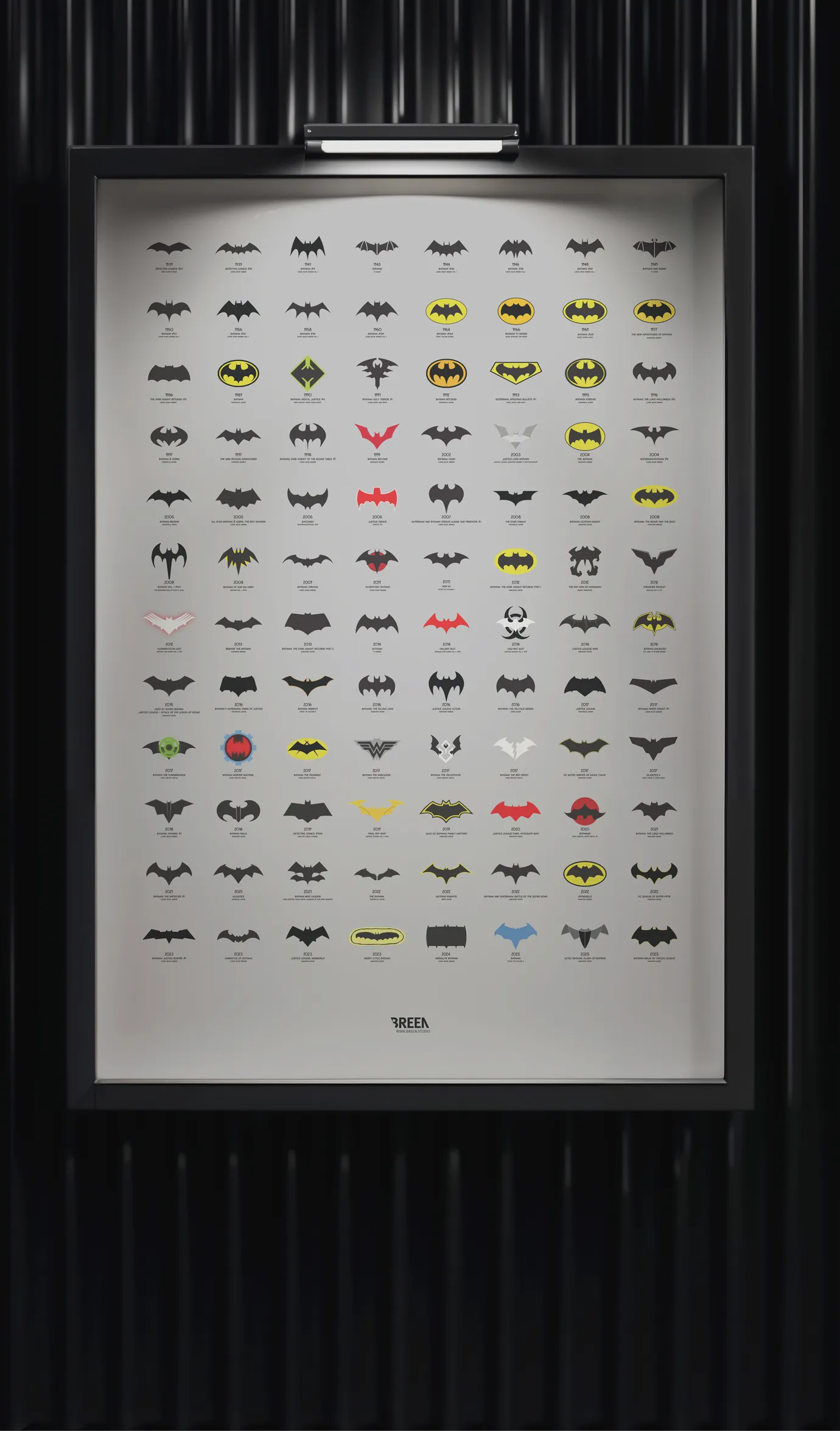
Batman Logo Evolution Poster
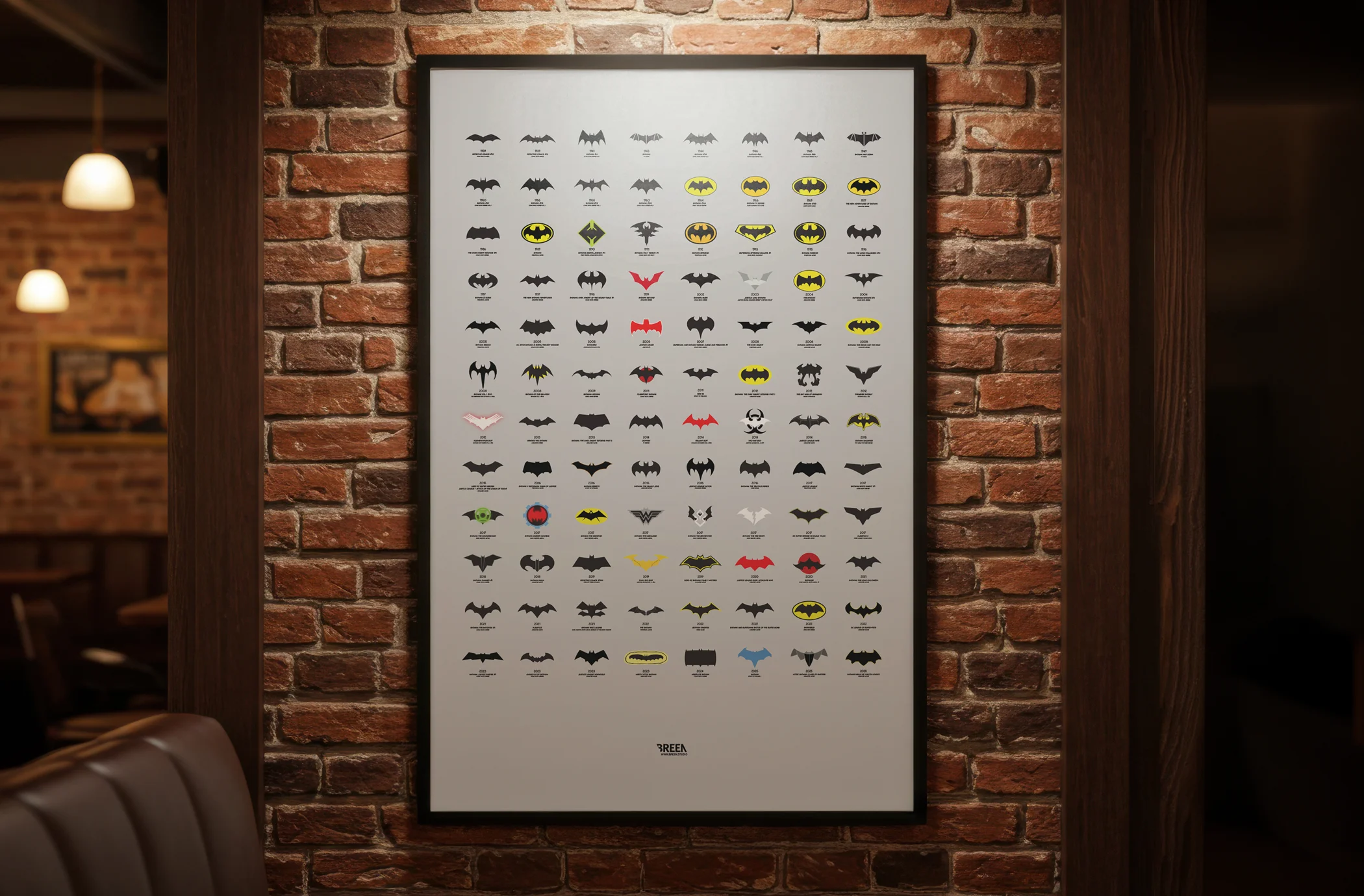
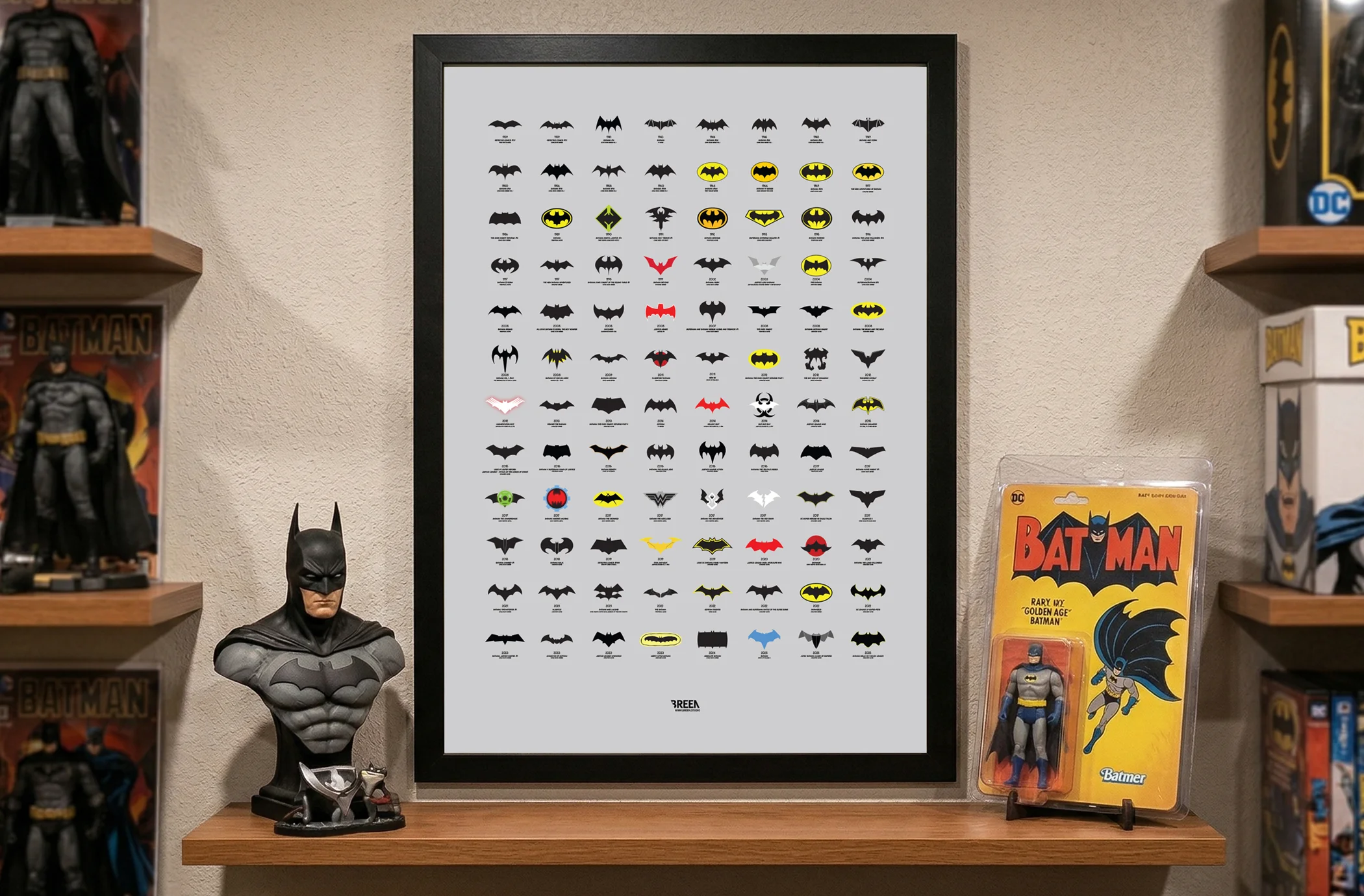
The most complete bat-symbol poster ever made. 96 unique logos Batman has worn across comics, film, TV, animation and games from 1939 to 2026.
Product Details
Size
A2 (420 × 594 mm / 16.5 × 23.4 in)
Paper
200gsm matte finish for minimal
reflections
Print
Giclée fine art - the same archival method used by museums
and galleries
Shipping & Returns
Shipping
Orders ship within 2–5 business days from the
Netherlands. €4.90 NL / €9.90 EU / €14.90
Delivery
EU: 3–7 business days. UK/US/CA: 5–12 business days.
Rest of world: 7–21 business days.
Returns
If your poster arrives damaged or misprinted, email a
photo within 30 days and we'll send a replacement, no questions asked. Lost in
transit? We'll reship at no cost.
87 years of the Batman logo
In 1939, Bob Kane and Bill Finger gave Batman a chest insignia that was barely more than a smudge — a small black shape with five pointed wings and no head. It looked less like a symbol and more like something caught in a windowpane. Eighty-six years later, that smudge has multiplied into one of the most redesigned logos in pop culture history. Most people know three or four versions. The yellow ellipse. The Nolan triangle. Maybe the big bruiser from Batman v Superman. But the actual count? It's far higher than you'd guess, and it keeps climbing.
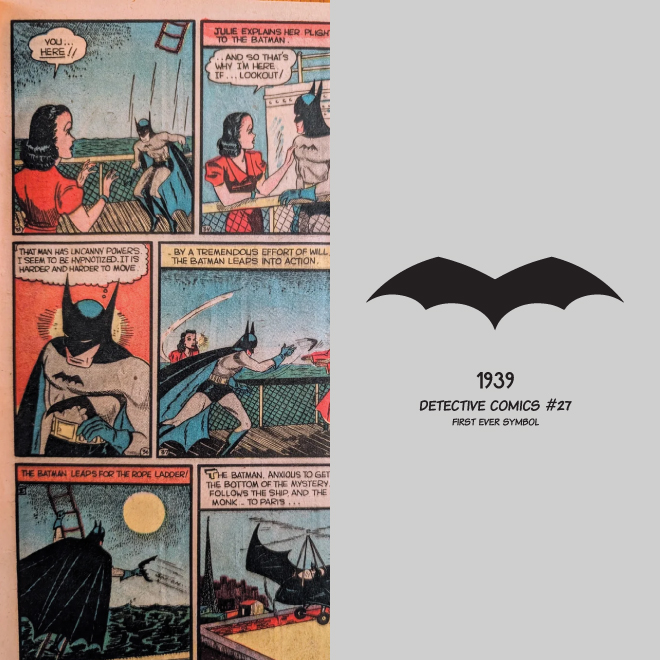
First ever bat-symbol, from Detective Comics #27 (1939)
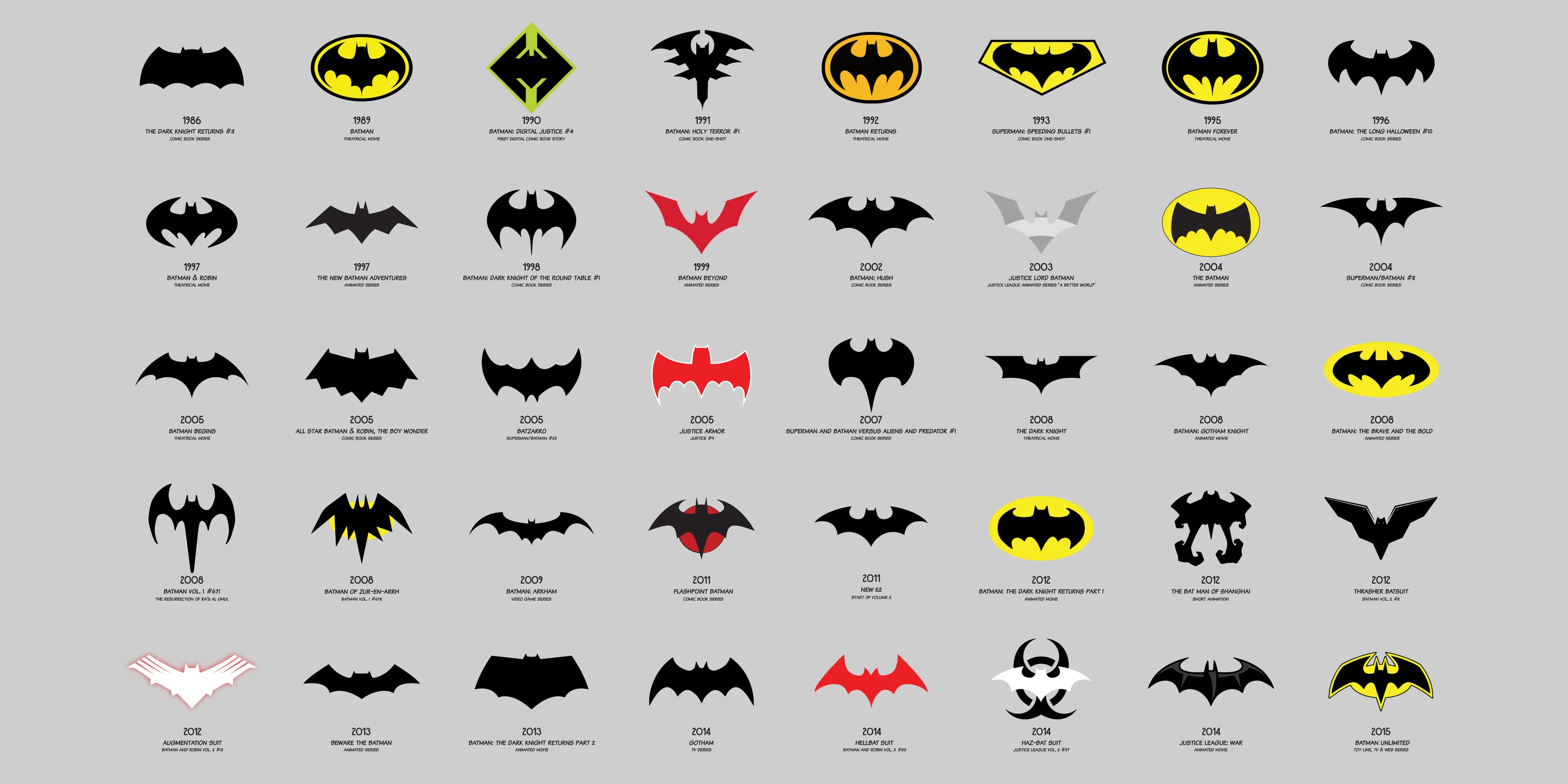
One bat, 96 costumes
Across comics, films, animated series, video games,
and one-shot alternate universes, Batman has worn at least 96 meaningfully distinct symbols on his
chest. Not cover art. Not promotional graphics. Not marketing material, these are the emblems Bruce
Wayne (and his many variants) actually suited up in.
Plenty of Batman logo posters mix chest symbols with comic covers,
movie
posters, and merchandise designs. The result is a messy catalogue that conflates what Batman
wore
with
what DC's marketing department slapped on a lunchbox. Strip all that away, and you're left with
something more focused and more revealing: a visual record of how one character's identity has been
redrawn, rethought, and reinvented across nearly nine decades of storytelling.
The quiet years and the yellow era
The early evolution is slower than you'd
expect. From 1939 to the early 1960s, the bat-symbol changed mostly in proportion: wings got wider,
then narrower, then wider again. The head appeared, disappeared, grew prominent, shrank back.
Artists
tweaked wing points from five to seven to nine without much consistency. Printing technology was
crude
enough that fine details often vanished on the page anyway.
Then 1964 changed everything. The bat landed inside a bright yellow ellipse, and suddenly
the
logo had presence. The version refined in 1966 — with the wings curving outward to fill the oval —
became the definitive Batman emblem for an entire generation. It held that position for over three
decades.
By 1969, the yellow ellipse had settled into what many fans still consider the most iconic
version of the bat-symbol. It's the one most people picture when they close their eyes and think
"Batman
logo." It's also the one the beloved Batman: The Animated Series used, a show so influential that
its
emblem became shorthand for the character across the 1990s.
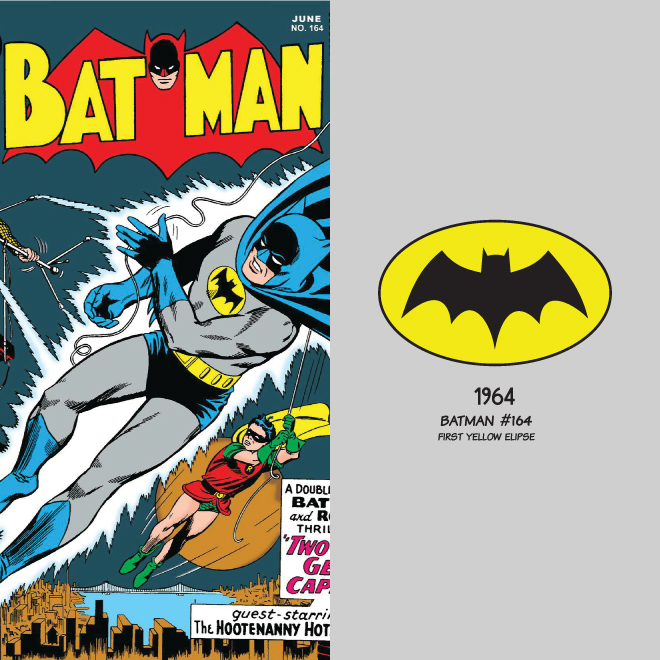
First yellow ellipse featured in Batman #164 (1964)
Volumes, reboots, and the symbols that marked them
Comics readers track Batman's
history in
volumes, and each new volume tends to bring a new chest symbol.
The 2011 New 52 relaunch — the start of Volume 2 — reorganized DC's timeline and gave Batman a
sharper,
more angular emblem. In 2016, the Rebirth era (Volume 3) introduced another redesign that carried
across
comics, animation, and games. And in 2025, Volume 4 arrived with yet another symbol, continuing the
cycle.
These volume shifts are the tent poles of the poster's timeline. But between them, the
variants
multiply. Every animated series, every film franchise, every video game adaptation introduces its
own
take. Christopher Nolan's trilogy used a geometric, almost aerodynamic bat, designed to double as a
throwable weapon in the films. Matt Reeves' 2022 The Batman went the opposite direction: small,
thin,
naturally proportioned, closer to an actual bat than any version before it.
And then there are the logos that never had to play by the rules at all.
The weird ones
DC's alternate universes — Elseworlds, the Dark Multiverse,
one-shot specials — are where the bat-symbol gets truly strange. Batman: Holy Terror reimagines
Bruce
Wayne as a priest, and the emblem reflects it. Batman: Digital Justice #4, the first fully digital
comic
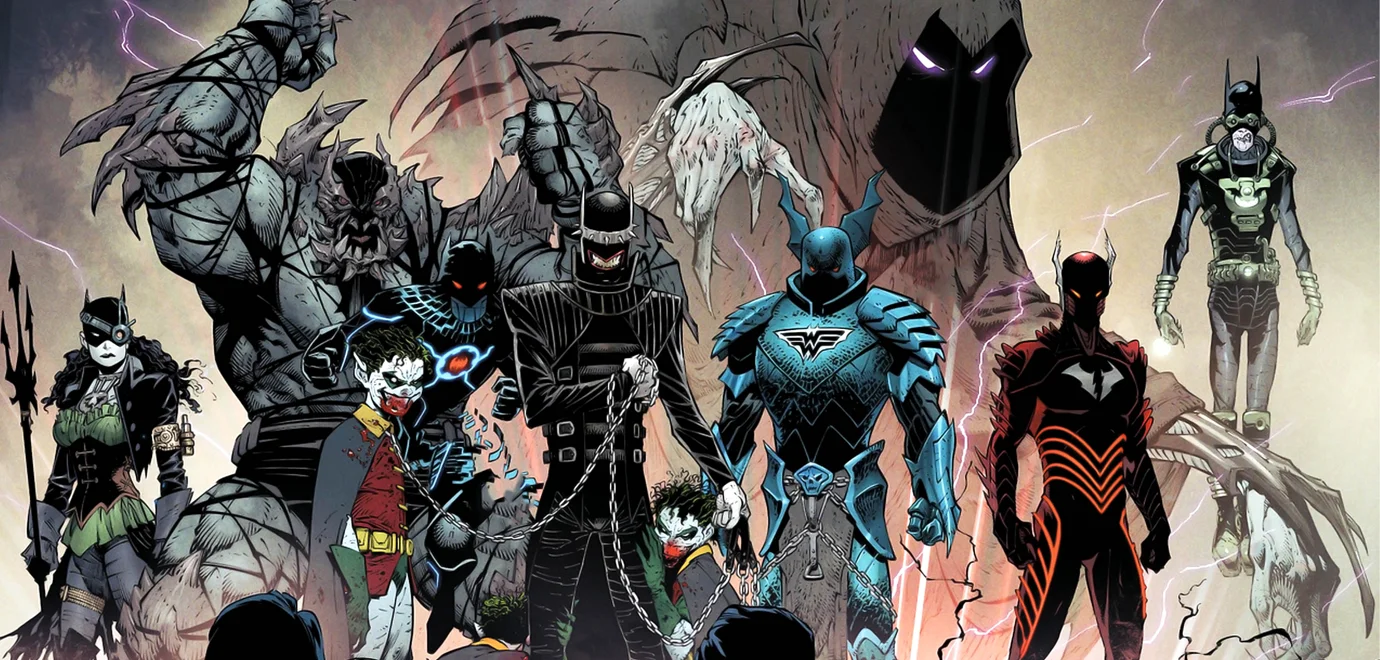
book ever made, carries its own distinct symbol. The 2017 Dark Nights: Metal event spawned an entire
gallery of corrupted Batman variants — the Dawnbreaker, the Drowned, the Merciless, the Devastator —
each with an emblem designed to feel wrong, like a bat-symbol from a universe where Batman lost.
These outliers are what push the count past anything a casual fan would expect. They're also
what make a chronological catalogue genuinely surprising: you think you know how many Batmen there
are,
and then you encounter Batzarro, or the Batman of Zur-En-Arrh, or the Justice Lord Batman from a
single
Justice League episode, and the number keeps growing.
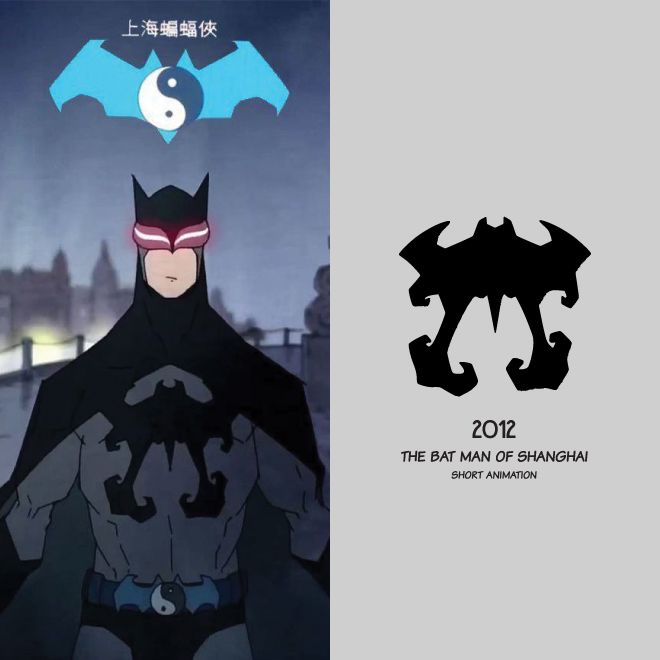
The Bat Man of Shanghai — one of the stranger symbols
Building the poster
Compiling 96 verified bat-symbols took several weeks of
research. Every Batman film, animated series, and major comic run had to be checked, not just
referenced, but visually confirmed. That meant watching scenes, pausing on chest plates,
screenshotting
frames, and retracing each symbol in Illustrator to ensure accuracy.
Some were straightforward. Others were not. The Bat Man of Shanghai, a short animation with
a
stylized art deco look, proved especially difficult to retrace faithfully. The Dark Nights: Metal
variants each required sourcing from specific comic panels. And the scoping decisions were constant:
if
two symbols looked nearly identical, only one earned a spot. If a famous series reused a logo
already
represented on the poster — as Batman: The Animated Series does with the 1969 classic — the series
couldn't appear separately, even though it deserved to.
The result is an 8-by-12 grid on A2 paper: 96 symbols arranged chronologically from
Detective
Comics #27 in 1939 to Batman Ninja vs Yakuza League in 2025. Each entry is labeled with the year,
the
title of the media it appeared in, and the format: comic book series, theatrical movie, animated
series, video game. It's an index designed to be read both as a timeline and as a collection, where
you
can trace the mainline evolution or let your eye wander into the strange corners.
What 96 symbols tell you
Laid out together, the bat-symbols reveal something the
individual versions can't. The early decades are sparse: a handful of variations over twenty-five
years. Then the yellow ellipse era holds remarkably steady for over thirty. But from the mid-2000s
onward, the count accelerates sharply. The 2017 Dark Nights: Metal event alone contributes half a
dozen
emblems. The 2020s already have more distinct bat-symbols than the entire 1940s through 1960s
combined.
That acceleration tracks directly with Batman's cultural footprint. One character in one
comic
became one character across every medium — and every medium wanted its own version. What started as
a
simple black shape on a gray suit became a design problem that hundreds of artists, costume
designers,
and animators have each solved differently. Ninety-six times and counting.
This Batman symbol poster is built for the person who wants all of those solutions in one
place: verified,
organized, and printed at a scale where you can actually study them. It works on a wall the way a
good
reference book works on a shelf: you'll check it once to settle an argument, and then you'll keep
noticing details you missed.
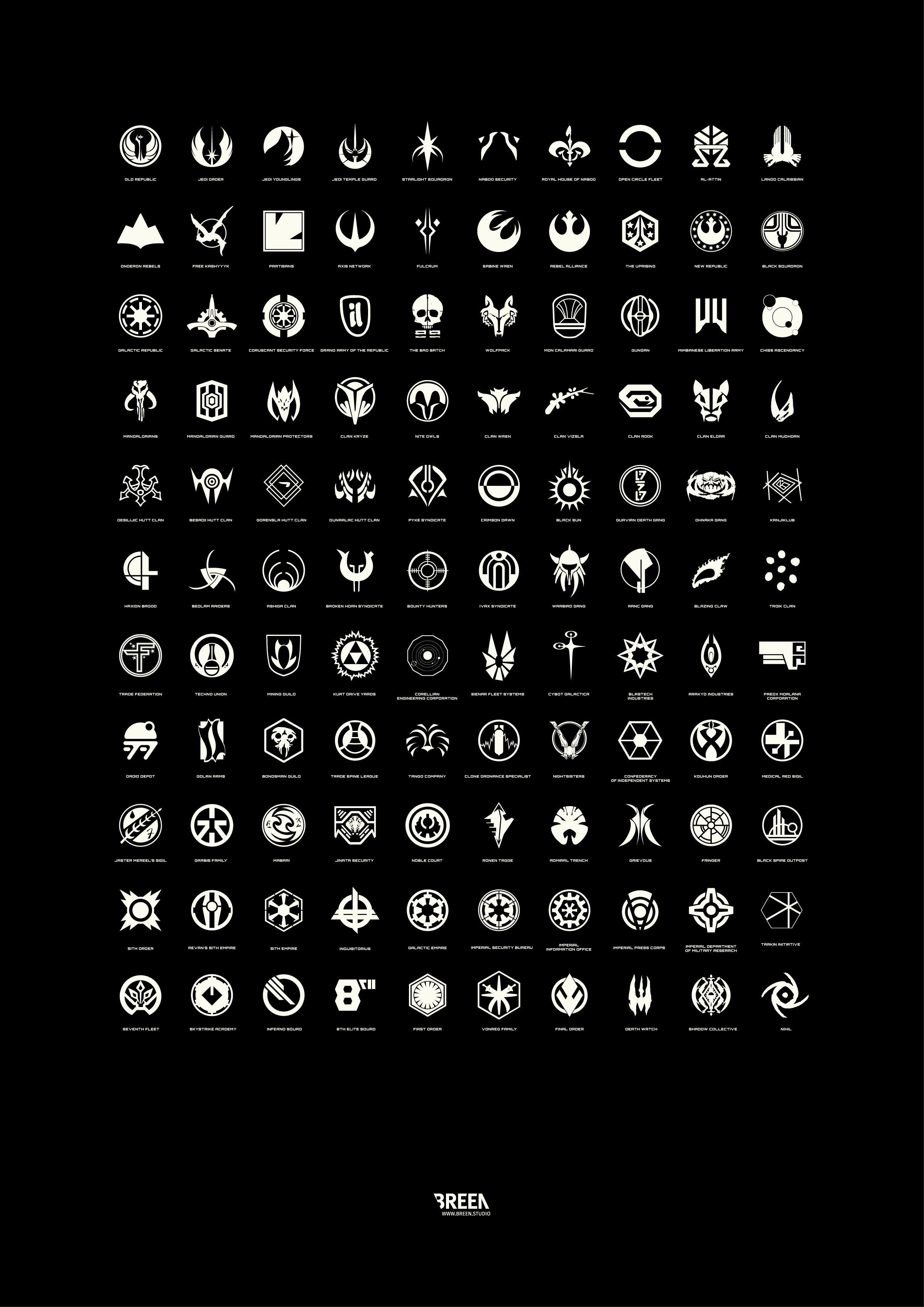
If you enjoy visual histories of pop-culture symbols, you may also like the Star Wars faction symbols poster.